
Planning to study abroad? IELTS is one of the most widely recognised English-language tests for international education.
The International English Language Testing System (IELTS) assesses your ability to communicate in English through four skills: Listening, Reading, Writing and Speaking.
If you’re planning to study at undergraduate or postgraduate level in an English-speaking country, IELTS Academic is generally the relevant test. IELTS General Training is designed for different purposes, including migration and training or study below degree level.
Your required IELTS score depends on your university, course and destination. So before booking your test, check the specific English-language requirements for every institution on your shortlist.
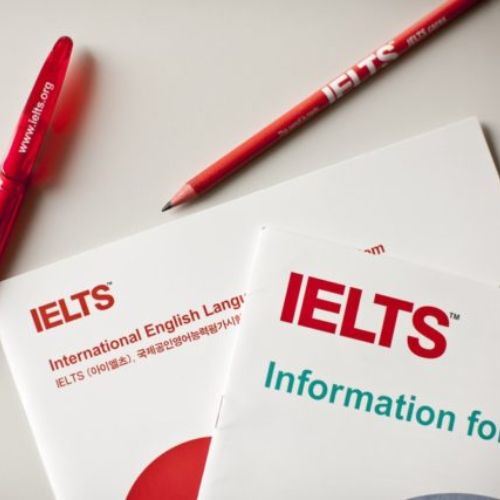
IELTS stands for International English Language Testing System.
It is an English-language proficiency test used for study, work and migration purposes.
For students, IELTS helps demonstrate that they have the English-language ability required for an international academic environment.
The test assesses four communication skills:
IELTS Academic is designed for people planning to study at undergraduate or postgraduate level, while IELTS General Training is commonly used for migration, work experience, training and study below degree level.
Depending on your purpose, you can choose between the following test types:
The IELTS test evaluates four English-language skills.
| Section | Approximate Duration | What It Tests |
|---|---|---|
| Listening | About 30 minutes | Understanding spoken English |
| Reading | 60 minutes | Understanding written English |
| Writing | 60 minutes | Written communication |
| Speaking | 11–14 minutes | Spoken English |
The IELTS Academic test takes approximately 2 hours and 45 minutes.
Choosing the right IELTS test is important because Academic and General Training have different purposes and different Reading and Writing components.
| Feature | IELTS Academic | IELTS General Training |
|---|---|---|
| Main purpose | University and higher education | Migration, work, training and other purposes |
| Undergraduate study | Generally suitable | Generally not the standard choice |
| Postgraduate study | Generally suitable | Generally not the standard choice |
| Listening | Same | Same |
| Speaking | Same | Same |
| Reading | Academic content | General Training content |
| Writing | Academic tasks | General Training tasks |
The Listening and Speaking sections are the same in both tests, while the Reading and Writing sections differ.
If you’re applying for an undergraduate or postgraduate course abroad, IELTS Academic is generally the appropriate choice.
However, don’t book a test based only on general advice.
Before booking, check:
The Listening section evaluates how well you understand spoken English.
It contains four parts with 40 questions. The recordings include different speakers and situations, and you hear each recording once. Different English accents may be used.
The Listening section can include:
The Reading section tests your ability to understand and interpret written English.
For IELTS Academic, the Reading test contains:
The texts can come from books, journals, magazines, newspapers and online resources and may include different writing styles.
The Writing section lasts 60 minutes.
For IELTS Academic, there are two Writing tasks, and both must be completed.
You are asked to describe or summarise visual information.
This can include:
You need to write at least 150 words.
You are given a point of view, argument or problem and asked to write an essay.
You need to write at least 250 words.
Task 2 contributes twice as much as Task 1 to the Writing score.
The Speaking test takes approximately 11–14 minutes and consists of three parts.
You’ll answer questions about familiar topics such as:
You’ll receive a topic and have one minute to prepare.
You then speak about the topic for up to two minutes.
The examiner asks further questions related to the Part 2 topic.
This section involves discussing ideas in greater depth.
IELTS uses a band score system from 0 to 9.
You receive individual scores for:
You also receive an overall band score. IELTS scores can be reported in whole and half bands, such as 6.0, 6.5, 7.0 or 7.5.
| Band | Description |
|---|---|
| 9 | Expert User |
| 8 | Very Good User |
| 7 | Good User |
| 6 | Competent User |
| 5 | Modest User |
| 4 | Limited User |
| 3 | Extremely Limited User |
| 2 | Intermittent User |
| 1 | Non-User |
| 0 | Did not attempt the test |
There is no single IELTS score required for every university or country.
The required score can depend on:
Some universities may also specify minimum scores for individual sections.
For example, a university may require an overall score while also asking students to achieve a minimum score in Writing or Speaking.
Before booking IELTS:
Shortlist universities → Check English requirements → Identify target score → Prepare → Take IELTS
Don’t assume that a score accepted by one university will automatically be accepted by another.
IELTS fees vary depending on the test type, location and test centre.
The fee may differ for:
Check the official IELTS or authorised test-centre website for the latest fee applicable to your location before booking the exam.
IELTS does not have one universal academic eligibility requirement like a university entrance examination.
The appropriate test depends mainly on why you need an English-language score and what organisation requires it.
Students may take IELTS for:
Make sure you know:
The time required to receive your IELTS result depends on the test format.
IELTS currently provides different result timelines depending on the test taken.
For the latest result timeline, always check the official IELTS information associated with your test.
If IELTS is part of your university application, don’t leave the test until the last possible moment.
Allow time for:
Test → Result → Application → Possible Retake → Visa Process
IELTS partners recommend that an IELTS result demonstrates English-language ability for a maximum period of two years.
However, individual organisations can have their own policies regarding older results.
Therefore, always check the requirements of:
IELTS One Skill Retake allows eligible test takers to retake one of the four skills:
This can be useful if you achieved your target scores in three sections but need to improve one particular skill.
However, availability depends on the test centre and test format.
More importantly, not every organisation necessarily accepts One Skill Retake.
Before booking a retake, check directly with your university or other organisation.
IELTS is moving to computer-delivered testing globally, with the official IELTS organisation announcing that paper-based IELTS will no longer be offered from mid-2026, with exact timelines varying by market. Selected markets may offer a Writing on Paper option while the rest of the test remains computer-delivered.
This means students should check the current test format available at their chosen test centre before booking.
A strong IELTS preparation plan should cover all four skills rather than focusing only on vocabulary or grammar.
Start by checking the English-language requirements of the universities you’re interested in.
If different universities require different scores, prepare for the highest relevant requirement.
Before beginning intensive preparation, take a diagnostic practice test.
This helps you understand:
Divide your preparation between:
Listening → Reading → Writing → Speaking
Regular practice is generally more useful than occasional long study sessions.
IELTS isn’t only about knowing English.
You also need to manage your time effectively.
Practise under realistic conditions so that the timing doesn’t become a problem on test day.
Don’t simply complete practice tests.
Record your mistakes and identify patterns.
Track:
This makes your preparation much more targeted.
Don’t automatically choose Academic or General Training.
Check which test your university, employer or relevant authority requires.
Know the score you need before starting serious preparation.
Writing requires more than vocabulary.
You need to understand structure, task response, grammar and coherence.
Memorised answers can sound unnatural.
Focus on expressing your ideas clearly.
You need to answer accurately and complete the test within the available time.
Give yourself enough time for the test, results and a possible retake.
Some universities require minimum scores in individual sections.
Always check the complete requirement.
Ideally, take IELTS early enough that your score is available before your university application deadline.
A practical timeline looks like this:
Choose your destination
↓
Shortlist universities
↓
Check English requirements
↓
Set your target IELTS score
↓
Prepare for the test
↓
Book IELTS
↓
Take the test
↓
Receive your result
↓
Apply to universities
↓
Begin visa preparation
Taking the test early also gives you more flexibility if you need to improve your score.
IELTS has test centres across many countries, and test options vary by location.
The official IELTS test-centre search allows you to check available test types, locations and other options.
For students in India, availability and test format can vary between cities.
Always check your local test centre before booking.
For international students, IELTS is only one part of the application process.
Your English-language score needs to fit into the wider study abroad plan.
You may also need to consider:
Getting the IELTS score is important, but choosing the right course and university is equally important.
IELTS stands for International English Language Testing System. It assesses four English-language skills: Listening, Reading, Writing and Speaking.
For undergraduate and postgraduate study, IELTS Academic is generally the appropriate test. Always confirm the requirement with your university and course.
IELTS Academic takes approximately 2 hours and 45 minutes, covering Listening, Reading, Writing and Speaking.
They are designed for different purposes. Their Listening and Speaking sections are the same, while their Reading and Writing sections differ.
IELTS uses a 0–9 band scale, with individual scores for the four skills and an overall band score.
There is no universal score. Your required score depends on your university, course and destination.
Fees vary by test type and location. For example, the official IELTS listing for an IDP centre in Pune currently shows ₹19,000 for IELTS Academic and General Training on computer.
IELTS partners recommend a maximum validity period of two years, although individual organisations may have their own policies.
Yes. You can retake the complete IELTS test if you want to improve your result. Eligible test takers may also be able to use One Skill Retake for one section.
IELTS One Skill Retake allows eligible test takers to retake Listening, Reading, Writing or Speaking once after a complete IELTS test. Availability depends on the test centre and test format
Yes. IELTS offers computer-delivered testing, and test availability depends on your location. IELTS has also announced the transition away from paper-based testing, with market-specific timelines.
Flying Chalks Overseas can help students understand their study abroad requirements, university options, application planning and English-language requirements.
For official IELTS test availability, fees and booking information, students should also check the official IELTS test-centre information.
IELTS preparation becomes much easier when you know why you need the score and what target you are working toward.
Instead of preparing without a clear goal:
Check your university requirements → choose the right IELTS test → set your target score → prepare strategically → take the test → use your result in your application.
The earlier you understand your requirements, the easier it becomes to plan your entire study abroad journey.
Getting your IELTS score is an important milestone, but it is only one step toward studying abroad.
At Flying Chalks Overseas, we help students understand their options, shortlist suitable universities, plan applications and navigate the requirements involved in their international education journey.
Whether you’re still researching destinations or already preparing your university applications, getting the right guidance early can help you avoid unnecessary delays and confusion.
IELTS preparation shouldn’t begin with memorising hundreds of words or taking endless practice tests.
Start with the basics:
Know your target → choose the right test → understand the format → build your skills → practise under time limits → review your mistakes.
Most importantly, don’t choose your target score simply because another student achieved it.
Your requirement depends on your university, course and destination.
Plan around your own application requirements, prepare consistently and give yourself enough time before your university deadline.
Copyright © 2025 Flying Chalks Overseas | All Rights Reserved
WhatsApp us